
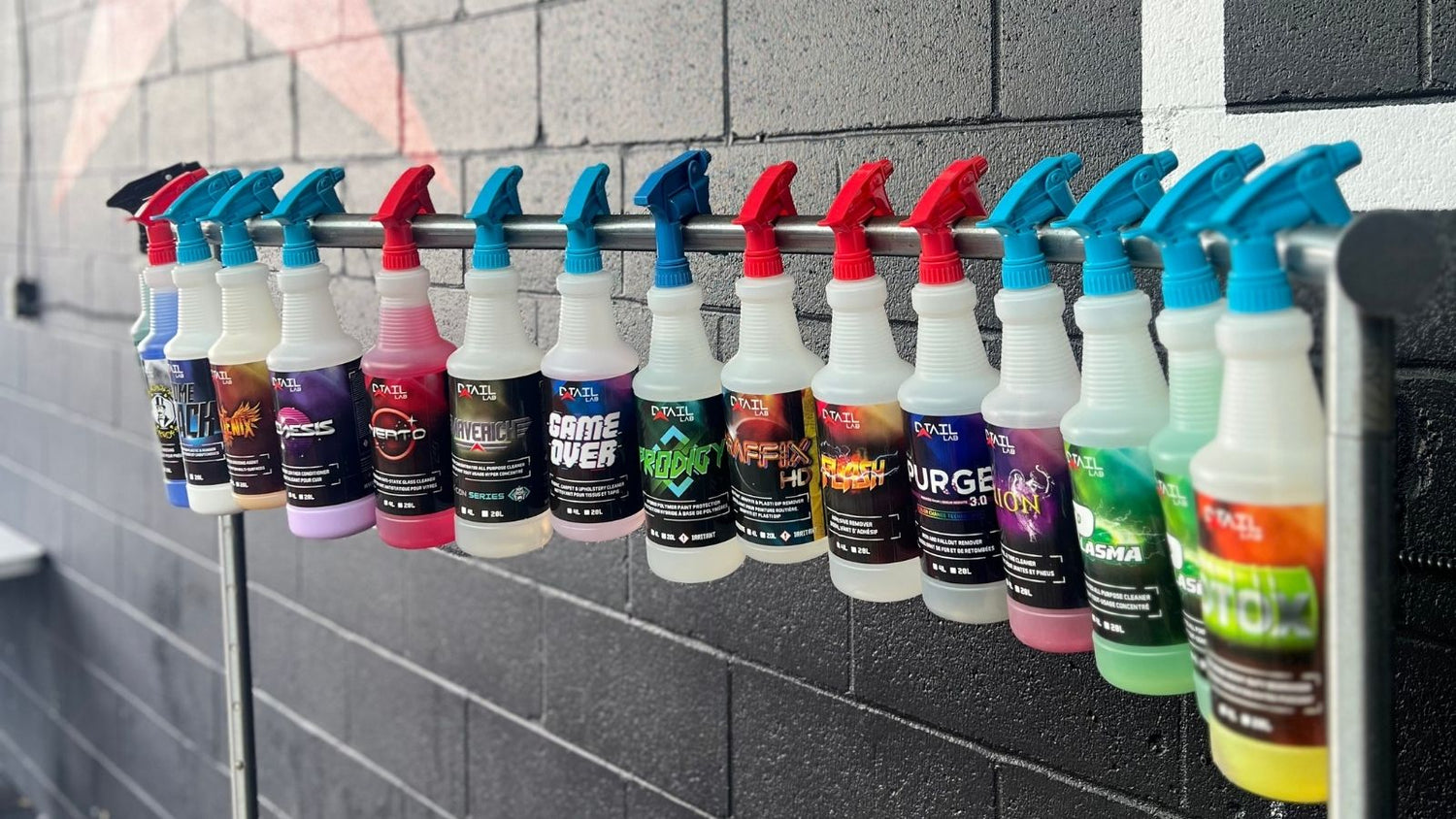
Nothing kills a shop’s workflow faster than grabbing a bottle mid-job, squeezing the trigger, and getting a handful of leaked chemical because the inner seals melted overnight. Standard sprayers simply aren't built to handle professional-grade detailing chemistry.
That’s why we’re introducing our Heavy-Duty Color-Coded Trigger Sprayers:
- Blue Sprayers equipped with EPDM seals and piston cups
- Red Sprayers equipped with FKM (Viton) seals and piston cups
While both feature heavy-duty high-output pumps, their internal seals are chemically engineered for entirely different jobs. Here is your ultimate guide to picking the right bottle for the right chemical so you never ruin a pump—or a client's paint—again.
1. The Blue Sprayer: EPDM Seals
Best for: High-pH Alkalis, Water-Based Cleaners & Alcohols
If your chemical is water-based, high on the pH scale (alkaline), or alcohol-driven, the Blue EPDM Sprayer is your go-to tool. EPDM (Ethylene Propylene Diene Monomer) thrives in contact with polar compounds, caustic bases, and water-based prep chemicals.
When to Grab the Blue Sprayer:
- High-pH Alkaline Wheel Cleaners & Degreasers: Perfect for heavy-duty caustic wheel cleaners and touchless wash soaps (pH 11+) that would cause standard FKM seals to degrade.
- IPA & Panel Prep Sprays: Isopropyl alcohol dries out and ruins standard seals, but EPDM handles high-concentration alcohol wipe-downs before ceramic coatings without flinching.
- Carpet & Upholstery Shampoos: Ideal for interior extraction chemistry, fabric cleaners, and stain removers.
- Water-Based All-Purpose Cleaners (APCs): The ultimate daily-driver bottle for tire, trim, and bug pretreatments.
- Water-Based Tire & Trim Dressings: Handles light-duty, milky spray dressings with ease.
Keep Away From: Petroleum solvents, solvent-based tire shines, bug and tar removers, mineral spirits, and strong inorganic acids. Petroleum causes EPDM seals to swell up like a sponge and jam.

2. The Red Sprayer: FKM (Viton) Seals
Best for: Strong Acids, Solvents & Hydrocarbons
When you bring out heavy organic solvents or harsh acid brighteners, the Red FKM Sprayer takes the field. FKM is a fluoroelastomer specifically designed to resist aggressive non-polar hydrocarbons, petroleum derivatives, and concentrated acids.
When to Grab the Red Sprayer:
- Acidic Wheel Cleaners & Brighteners: Strong inorganic acids (like phosphoric, hydrochloric, or hydrofluoric acid mixes) require the heavy acid resistance of FKM.
- Solvent-Based Bug & Tar Removers: Heavy-duty tar melts and adhesive removers turn regular rubber seals to goo, but FKM handles them effortlessly.
- Solvent-Based Tire Dressings: If you use high-gloss, long-lasting silicone/solvent-based tire shines, this is the only pump that won't fail after a few days.
- Engine Bay Solvent Degreasers: Designed for heavy solvent degreasers engineered to break down baked-on grease, oil, and grime under the hood.
- Solvents & Mineral Spirits: Excellent resistance against petroleum distillates, xylene, and naphtha-based formulations.
Keep Away From: Pure acetone, high-concentration alcohol mixtures, and high-pH caustic alkalis. These polar solvents and strong bases cause FKM to swell and lose structural integrity.

Cheat Sheet: Quick Chemical Selection Guide
Use this handy reference guide to outfit your shop's detailing cart:
| Detailing Product / Chemical Type | Recommended Sprayer | Internal Seal Material |
|---|---|---|
| IPA / Paint Prep Cleaners | Blue Sprayer | EPDM |
| Alkaline Wheel Cleaners (High pH) | Blue Sprayer | EPDM |
| Water-Based APC & Fabric Cleaners | Blue Sprayer | EPDM |
| Water-Based Tire Dressings | Blue Sprayer | EPDM |
| Acidic Wheel Cleaners / Brighteners | Red Sprayer | FKM (Viton) |
| Solvent Bug & Tar Removers | Red Sprayer | FKM (Viton) |
| Solvent-Based Tire Shines | Red Sprayer | FKM (Viton) |
| Engine Bay Solvent Degreasers | Red Sprayer | FKM (Viton) |
| Adhesive Removers / Mineral Spirits | Red Sprayer | FKM (Viton) |
Pro Shop Tip: Work Smarter, Stop Replacing Pumps
Color-coding your bottles isn't just about seal longevity—it’s also a key safety protocol for your shop.
By keeping Blue for Water/Prep/Alkalis and Red for Acids & Solvents, your detail techs can instantly identify what’s inside a bottle at a glance, preventing costly cross-contamination (like accidentally spraying a solvent tire shine onto a leather seat).
Pairing the right seal with the right chemistry means zero downtime, zero wasted product, and sprayers that last season after season.

Leave a comment
This site is protected by hCaptcha and the hCaptcha Privacy Policy and Terms of Service apply.