
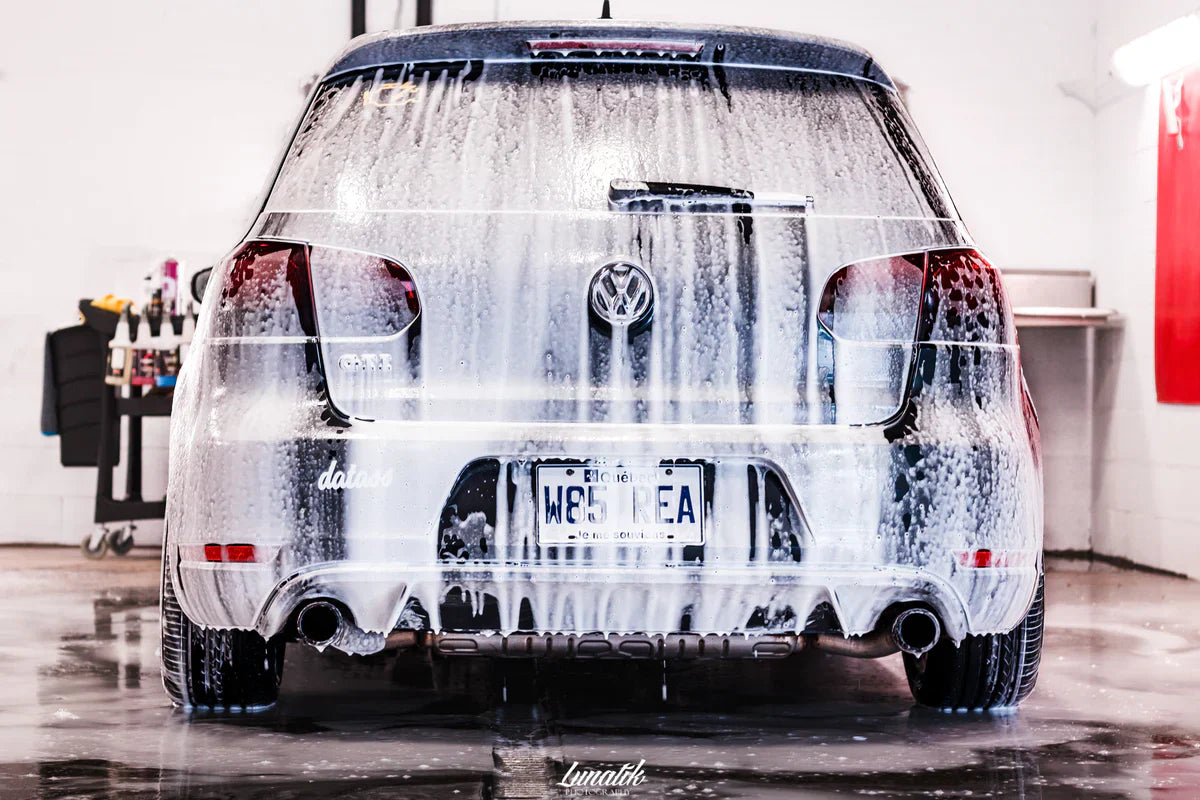
What Is a Pre-Wash (Pre-Soak)?
A contactless pre-wash — also called a pre-soak or traffic film remover (TFR) — is the step where you apply a cleaning solution to your vehicle's exterior before any physical contact with a wash mitt or sponge. The goal is simple: let the chemistry do the heavy lifting so you don't have to scrub as hard, and so there's less grit on the surface when you do make contact.
As a professional or simply as a car owner, you know how important it is to keep your vehicle in good condition. The best way to do this is by regularly cleaning your car, but it's more than just a simple hose and soap job. The pre-wash is one of the most important steps to ensure your vehicle stays looking its best.
Pre-Wash vs. Pre-Soak: What's the Difference?
The terms are often used interchangeably, but there's a subtle distinction:
- Pre-wash refers to the overall step — applying a solution and rinsing it off before the contact wash.
- Pre-soak emphasizes the dwell time — letting the product sit and penetrate the grime so it loosens on its own.
In practice, a good pre-wash is a pre-soak. The key is giving the product enough time to work before rinsing.
What Pre-Soak Does
A contactless pre-wash removes a substantial amount of dirt, bugs, and grime from the vehicle exterior. This limits the risk of spreading everything all over with your wash mitt and scratching the paint. A dedicated pre-soak cleaning solution is generally more potent than your standard car shampoo, breaking down traffic film, road salt, grease, and organic contaminants that water alone can't touch.
Why Pre-Washing Reduces Wash-Induced Scratches
Every time you touch your paint with a mitt or sponge, there's a risk of micro-marring — tiny scratches caused by dragging particles across the clear coat. The more dirt that's on the surface when you start washing, the higher that risk. By removing the bulk of loose contamination without contact, a pre-soak dramatically reduces the amount of abrasive material left on the surface for the contact wash phase.
Think of it this way: if you could wash your car without ever touching it, you'd never get swirl marks. A pre-soak gets you as close to that ideal as possible.
How to Pre-Wash a Car: Step by Step
- Park in the shade. Avoid working on hot panels or in direct sunlight — the product can dry before it has time to work.
- Rinse the vehicle first. A light rinse with water removes loose dust and cools the surface.
- Apply your pre-wash solution. Use a foam cannon or pump sprayer to coat the vehicle evenly. Dilute the product according to the manufacturer's instructions.
- Let it dwell. Give the foam time to penetrate and break down grime — dwell time varies by product (for Rogue Pre-Wash, 3–5 minutes). Don't let it dry on the surface.
- Rinse thoroughly. Use a pressure washer or strong hose stream to blast away the loosened contamination.
- Proceed with your contact wash. Now that the heavy dirt is gone, your wash mitt and contact shampoo can clean the remaining film safely.
Foam Cannon vs. Pump Sprayer
The best way to apply the pre-wash solution is using a foam cannon connected to a pressure washer. A foam cannon produces super thick foam by mixing high-pressure water flow from your pressure washer with your pre-wash cleaning solution. The foam helps the cleaning agent cling to the surface longer, giving you more working time before it dries or drips off your vehicle.
If you don't have access to a pressure washer, there are also excellent manual foaming options on the market. A pump sprayer like the Marolex Axel Foam Sprayer produces a thick foam without the need for a pressure washer, making it a practical option for home use.
''Foaming your car is so satisfying''
Dwell Time: How Long Should Pre-Soak Sit?
Dwell time — the period the product sits on the surface before rinsing — is critical. Dwell time varies by product — some need as little as 3 minutes, others up to 10. For Rogue Pre-Wash specifically, a dwell of 3–5 minutes is recommended. Factors that affect dwell time include:
- Temperature: Warm weather shortens dwell time (product dries faster). Work in sections if needed.
- Soil level: Heavily soiled vehicles benefit from longer dwell, but never let the product dry completely.
- Product concentration: A stronger dilution may work faster, but always follow the manufacturer's recommended ratios.
When to Rinse
Rinse when the foam starts to break down and run off — typically when you see it turning from thick white foam to a thin, watery film. If the product dries on the surface, it can leave residue and be harder to remove. When in doubt, rinse sooner rather than later.
Pre-Wash Chemistry: What to Look For (and What to Avoid)
The pre-wash is usually done using a dedicated pre-soak cleaning solution, and it's generally more potent than your standard car shampoo. That said, many pre-wash products are highly alkaline, and some even contain caustic chemicals.
While being cheap and really effective, caustic chemicals should not be used for cleaning cars because they can be very damaging to the paintwork and can cause oxidation or discoloration in the long run. Caustic cleaners are highly corrosive, so using them can dissolve away the protective coating on the car's exterior, leaving it vulnerable to further damage.
Look for products specifically designed for automotive exterior use — alkaline pre-washes can be highly effective as long as they are caustic-free and used as directed. Speaking of foaming and cleaning capabilities, many customers have found Rogue Pre-Wash capable of removing most of the traffic film and dirt when used as a pre-soak, but also very effective as a contactless wash when performed on a regular basis in between the whole cleaning routine. Furthermore, Rogue also contains rust inhibitors and is caustic-free, so it's tough on dirt, but gentle on paint finish and won't hurt your paint protection.
Ceramic Coating Compatibility
If your vehicle has a ceramic coating or paint protection film, pre-washing is not just safe — it's recommended. Coatings repel water and contaminants, which means a contactless pre-soak can remove a surprising amount of grime on its own. Compatibility depends on the product being designed for automotive exterior use and used according to its dilution, dwell-time, and rinsing instructions. An alkaline but caustic-free pre-wash like Rogue is designed for exterior automotive use and is compatible with ceramic coatings when used as directed.
While Rogue has also proven to remove light contamination, proper paint decontamination with an iron remover like ThePURGE should be performed at least twice a year or more or less depending on the vehicle usage and condition.
Common Pre-Wash Mistakes to Avoid
- Skipping the pre-rinse. Rinsing first removes loose dust and cools the panels. Skipping it means you're asking the pre-soak to work harder than necessary.
- Letting the product dry. Dried pre-wash can leave water spots and residue. Work in sections or in the shade.
- Using too much product. More foam isn't always better. Follow dilution ratios — over-concentrating can waste product and leave residue.
- Using caustic cleaners. Cheap industrial degreasers can strip wax, sealant, and ceramic coatings. Stick to automotive-specific pre-wash products.
- Rushing the dwell time. If you rinse too quickly, the product hasn't had time to break down the grime. Patience pays off.
Frequently Asked Questions
What is pre-soak at a car wash?
Pre-soak is the step where a cleaning solution is sprayed onto the vehicle before the main contact wash. At automatic car washes, it's the high-pressure spray of chemical solution you see applied as soon as your car enters the bay. At home, it's the foam or spray you apply before touching the car with a mitt.
Can I use regular car soap as a pre-wash?
You can, but dedicated pre-wash products are formulated to break down traffic film and grime more aggressively than contact wash soaps. A product like Rogue Pre-Wash is designed specifically for this step, whereas a regular shampoo is optimized for lubrication during the contact wash.
How often should I pre-wash my car?
Every time you wash. The pre-wash should be the first step of every wash routine, whether you wash weekly or monthly. It takes a few extra minutes and significantly reduces the risk of paint damage.
Is pre-wash safe for ceramic coatings?
Yes, an automotive pre-wash can be compatible with ceramic coatings when used at the manufacturer's recommended dilution and dwell time. Rogue, for example, is an alkaline but caustic-free pre-wash designed for exterior automotive use. Pre-washing is actually ideal for coated vehicles because the coating's hydrophobic properties help the loosened dirt rinse away easily.
Do I need a pressure washer for pre-washing?
No. A foam cannon connected to a pressure washer produces the thickest foam, but a pump sprayer like the Marolex Axel Foam Sprayer works well without one. You can even use a spray bottle, though the foam won't be as thick or cling as long.
If you enjoy car detailing and would like to learn more, feel free to subscribe to our newsletter so you can be notified when we post more content! If you would like to share your knowledge with the community, please contact us and tell us your story and we'll post it here!



1 comment
Sylvain pineau
Bonjour, où puis-je me procurer le shampoing de pré lavage pour auto , j’ai un vus kia sportage 2018.merci
Leave a comment
This site is protected by hCaptcha and the hCaptcha Privacy Policy and Terms of Service apply.